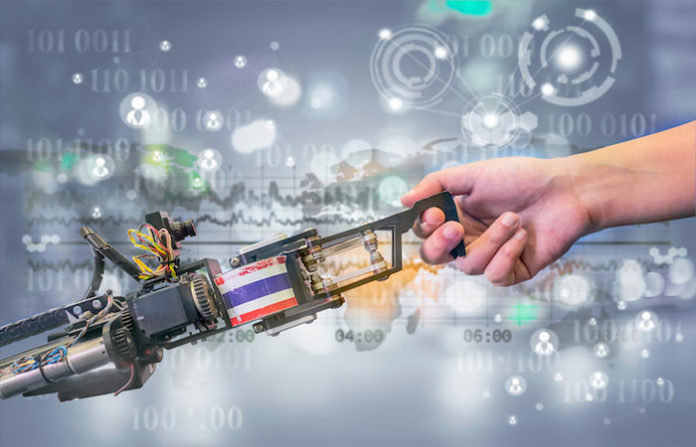


The digital world and industry unite in the new industrial revolution. Industry 4.0 is among the most popular concepts of recent times. What does this concept, which heralds a new industrial revolution, mean exactly? Is he here? Will he come? So when will he come? These questions continue to puzzle the global business world.
Industry 4.0, which was first expressed in 2012 and presented as the report on April 8, 2013 at the world’s largest industrial fair Hannover Fair, is one of the most frequently encountered concepts in technology and business. What is this new industrial revolution that emerged in Germany and is now at the center of the global industrial world? What are the technology segments that uncovered Industry 4.0? And most importantly, how will this new industrial understanding affect us?
The first industrial revolution, which came with mechanization, followed the second industrial revolution, which brought mass production together. We also welcomed the third industrial revolution with the automation system that came with the robotic systems. It is now the fourth industrial revolution that came with digitization, namely Industry 4.0. In fact, we can all feel that we are now in the digital world. With smartphones or mobile devices, we can connect to the world digitally every time. The echo in the business world started with the digitization of the production process. Following this, intelligent systems, IoT (Internet of Objects), 3D technology and cloud data completely change the traditional production concept, offering a digital, intelligent and independent industry platform.
The digital world and industry unite in the new industrial revolution
We are entering into this industrial revolution that combines computer and automation to create a brand new digital business platform. Devices connected with IOT technology can exchange information and data with each other. Thanks to this technology, electronic systems, sensors and processors can be integrated with different tools and equipment. The interconnected system and IOT, which make automation of machines so nearly elevated and almost independent, have been incorporated into most leading companies. This system, which companies are still in the process of getting accustomed to, has received very positive feedbacks, increasing productivity and reducing human loyalty.
This system, which facilitates the data tracking process in production and development process and takes any gaps in the process, production time, cost, and, of course, man power. If some of the deficiencies found in the IOT process that has already entered the frame of many companies, even though it is a new market, it is stated that this technology will be a system that will become a necessity of the companies and increase the competition in the market.

An important element supporting IOT
An important element supporting IOT is the system associated with cloud data; This ability to share processor power and memory in the company makes it possible to use the service in the most efficient way. This system, which is now used by many companies, offers a significant cost savings. Because companies do not buy their own hardware, they only use as much of the cloud services as they use. In addition to the savings that it provides, this system, which also provides the possibility of backup, is highlighting the companies.
Although IOT and cloud data are the technologies that open the doors of the digital world, they bring with it some problems. The most important of these is of course the security problem. Firms, systems whose equipment does not belong to them; they are uploading data that should not be passed by a third person, which would create problems. Although there are some encryption and security systems developed for this problem, a precise solution has not yet been found.
One of the most important parts of Industry 4.0 is 3D printing
One of the most important parts of Industry 4.0 is 3D printing, which completely changes the way people think about production. This technology, also called layered production, The industry is defined as a technological revolution that affects everyday life as well as being one of the technologies that motivate the 4.0 and ruins it. This technology, which makes the consumer society productive, reshapes the production process. In the last 5 years; It is anticipated that 3D production; which has started to be used intensively in important industrial sectors; such as aviation, medical, automotive, will have a say in mass production in the near future.
But just like other technologies, some obstacle-based 3D production has to go through significant developments; to fully demonstrate its potential and change the direction of the manufacturing world. In the ever-growing 3D market, the speed of printing, the robustness and functionality of the materials; and the print run are still on the agenda. Accordingly, the R&D centers and producers that conduct their work are undertaking a number of printing techniques; and materials development projects to make tiered production faster, more practical and less costly. If these studies have serious consequences then it is officially acknowledged that Industry 4.0 is coming